
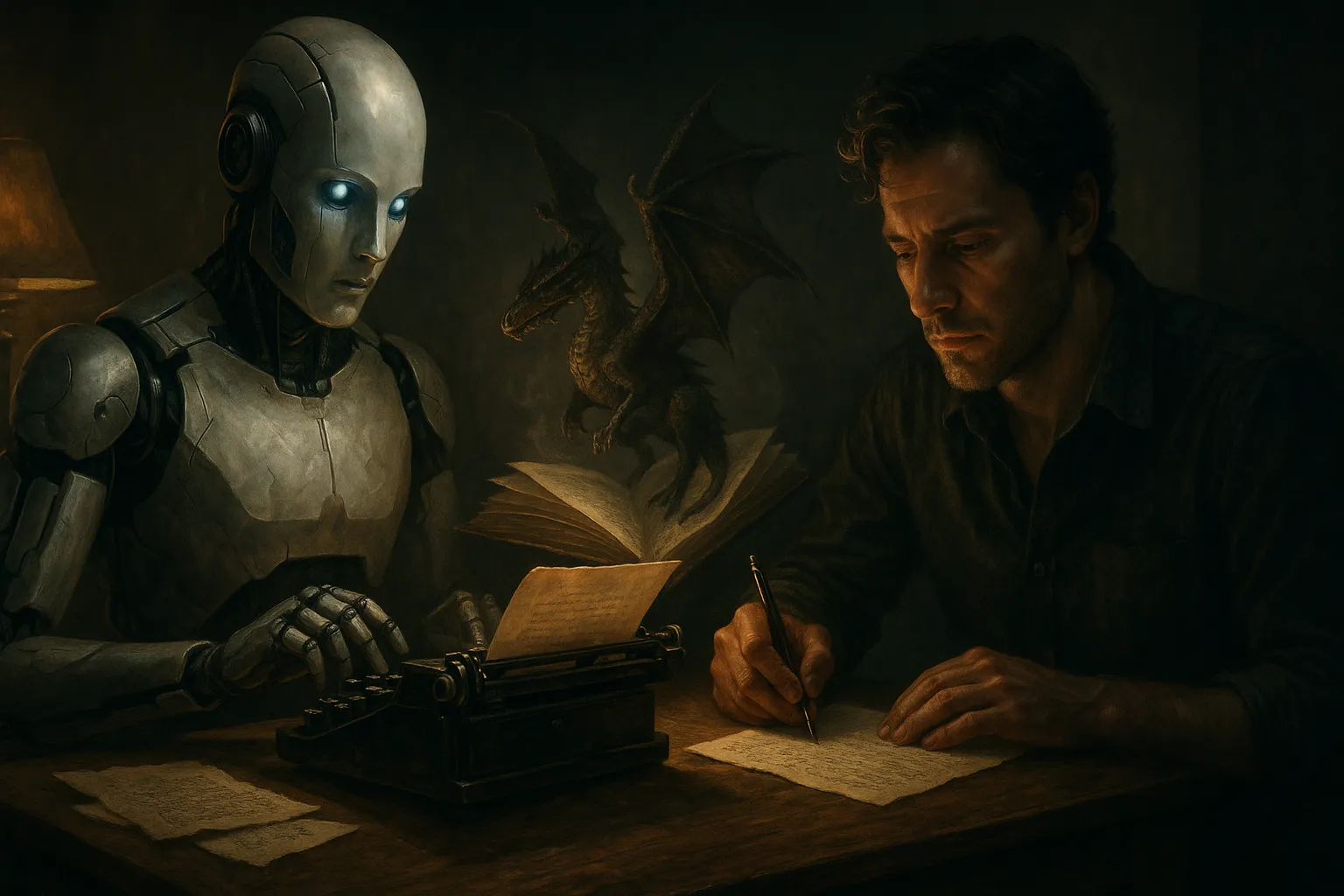
AI writing doesn’t mean asking a chatbot to produce a novel. It means using language models as a creative tool — for brainstorming, worldbuilding, drafting, editing, and maintaining consistency across a long manuscript. The fiction authors getting real results in 2026 aren’t replacing their creative process. They’re accelerating the parts that used to be pure labor.
But the gap between “AI-assisted writing” done well and done poorly is enormous. The difference almost always comes down to one thing: context. Give an AI a generic prompt and you get generic prose. Give it your characters, world, outline, and voice — and the output is dramatically more useful.
This guide covers how AI writing actually works, what the tools look like in 2026, why context matters more than model choice, and a practical workflow you can apply to your next project.
What AI Writing Actually Is (and Isn’t)
Creative writing AI has evolved rapidly, but there’s still widespread confusion about what it actually does. AI writing for fiction is not autocomplete. It’s not a grammar checker with delusions of grandeur. And it’s not a ghostwriter you feed a premise and walk away from.
At its core, AI writing uses large language models (LLMs) — neural networks trained on massive text datasets — to generate text based on a prompt you provide. The model doesn’t “understand” your story. It performs sophisticated pattern prediction: given this context, what text should follow? The result is coherent prose that matches the patterns of whatever you’ve asked it to produce.
That pattern prediction happens on a spectrum of usefulness for fiction writers:
Brainstorming and ideation. AI is excellent at generating options — character concepts, plot complications, “what if” scenarios, thematic connections. You provide a seed, the model gives you twenty variations, and you pick the three that spark something.
Outlining. Feed the AI your premise and characters, and it can suggest story structures, scene breakdowns, and beat sheets. The output needs heavy curation, but it’s faster than staring at a blank outline template.
Drafting. This is where the biggest time savings live. Given a detailed scene outline and character context, AI can produce a first draft of a scene in seconds — hitting the right beats, maintaining the right POV, and referencing your established world. That draft needs editing, but it gets you past the blank page.
Editing and revision. AI tools can scan for tense inconsistencies, suggest ways to expand or condense a passage, rephrase for clarity, and flag potential plot holes. Some writers use general-purpose AI (like ChatGPT or Claude) to get developmental feedback on pacing and character arcs.
Consistency checking. For series writers managing thousands of pages of lore, AI can cross-reference character details, timeline events, and world rules — catching the kind of continuity errors that human eyes miss on the fifth re-read.
What AI Does Well
AI excels at the labor-intensive parts of writing. Turning a beat sheet into a first draft. Generating fifty name options for a secondary character. Checking whether your magic system contradicts itself in chapter 23. Producing three different versions of a scene opening so you can pick the strongest.
Speed is the real advantage. An AI can draft a 2,000-word scene in 30 seconds. Not a publishable scene — but a working first draft that captures the right beats and gives you material to sculpt.
What AI Does Badly
Voice. The thing that makes your prose sound like yours — the rhythms, the word choices, the particular way you structure a paragraph — is exactly what AI struggles to replicate. It can approximate genre conventions (literary fiction cadence, thriller pacing, romance warmth), but it defaults to a competent, anonymous middle register.
Humor. AI can identify where a joke should go and produce something structurally joke-shaped. Genuinely funny prose? Rarely.
Emotional depth. AI describes emotions (“she felt a wave of grief”) instead of evoking them. The specific, surprising physical detail that makes a reader’s chest tighten — “she kept rearranging the salt shaker, squaring it with the edge of the placemat” — that’s still a human skill.
Surprise. LLMs predict the most likely next token. By definition, they trend toward the expected. The strange metaphor, the structural break, the moment that makes a reader stop and re-read a sentence — those come from the author, not the model.
Knowing when to break rules. AI has absorbed millions of pages of “correct” writing. It struggles with deliberate rule-breaking: the sentence fragment for impact, the run-on that mirrors a character’s panic, the comma splice that a copyeditor would flag but a reader would feel.
AI is a tool in your creative process. A powerful one. But craft — the hard-earned skill of knowing what to write, when to hold back, and how to make a reader feel something — remains yours.
Why Context Changes Everything
This is the single most important concept in AI-assisted fiction writing: the quality of AI output depends almost entirely on the context you provide.
A prompt like “write a fantasy scene” produces generic fantasy. The same model, given a character profile (Elena: cautious, analytical, hiding a secret identity), a lore entry (the Thornwall Archive holds forged trade documents), an outline beat (Elena breaks in, finds the evidence, gets caught by a sympathetic archivist), and a voice reference (third person limited, past tense, tense and urgent) — produces a scene grounded in your specific story.
The gap between those two outputs isn’t a small improvement. It’s the difference between useless filler and a workable first draft.
Generic Prompt, Generic Output
When authors say “AI writing is generic,” they’re usually describing what happens with minimal context. A bare prompt forces the model to invent everything — characters, setting, conflict, voice — and it defaults to the most statistically average version of each. The result reads like a competent creative writing exercise. Not bad, exactly, but not yours.
Rich Context, Useful Output
When you feed the AI your character profiles, world rules, story outline, previous scenes, and voice instructions, you’re constraining the model’s output space. Instead of predicting “what text would generally follow this prompt,” it’s predicting “what text would follow this prompt, given these specific characters, this world, this plot, and this voice.” The result is dramatically more specific, consistent, and useful.
Two Ways to Provide Context
Copy and paste. Open ChatGPT or Claude. Paste your character profiles, world bible, and outline into the conversation. Prompt for a scene. This works — especially for brainstorming and short projects — but gets unwieldy for novel-length fiction. You’re manually curating context for every generation, and conversation windows have limits.
Use a tool with structured context built in. AI fiction editors like Laterpress, Novelcrafter, and Sudowrite maintain structured databases of your characters, world, and outline. When you generate a scene, the tool automatically feeds relevant context to the AI model. You don’t curate prompts — the tool does it for you, drawing from everything you’ve built in your project.
The second approach scales. For a 300-page novel with 12 POV characters and a detailed magic system, manually pasting context into a chat window becomes impractical. A tool that automatically provides the right context for each scene is the difference between AI writing that works and AI writing that produces contradictory, off-character prose.
Story Structure as Context
Here’s something that isn’t obvious: your outline is context too. When the AI knows that this scene is the midpoint reversal, that the protagonist just discovered the mentor’s betrayal, and that the next scene is a confrontation — it writes differently than if you just said “write the next scene.”
Scene-by-scene beat sheets are especially powerful as AI context. Each beat constrains what the AI generates: the specific plot events, the emotional arc, the pacing. Authors who outline in detail before generating get dramatically better results than those who freeform prompt.
The Foundation Model Argument
There’s a persistent assumption in AI writing that specialized, fine-tuned models produce better fiction than general-purpose models. The research suggests otherwise.
A 2023 Microsoft study tested GPT-4 (a general-purpose model) against Med-PaLM 2 (a model specifically fine-tuned on medical data) on clinical reasoning tasks. With strong prompting and rich context, the generalist GPT-4 matched or exceeded the specialist model (Nori et al., 2023).
The same dynamic plays out in creative writing. A top foundation model — given your character profiles, world lore, outline, voice instructions, and previous scenes — produces output that’s more flexible, more current, and more responsive to your specific story than a fine-tuned model working from a generic prompt. The fine-tuned model may produce more polished prose out of the box, but the foundation model with rich context adapts to your story instead of regressing to average fiction.
This is why tool choice matters. The tools that give AI models the richest, most structured context — not the tools with the most specialized fine-tuning — tend to produce the best results over the course of a full novel.
How Fiction Writers Actually Use AI in 2026
The authors getting the most from AI aren’t using it for one thing. They’re integrating it across their entire workflow — different tools and techniques at each stage.
Brainstorming and Ideation
AI is a tireless brainstorming partner. Feed it a half-formed idea and ask for twenty variations. Describe a character and ask for potential backstory complications. Outline a plot and ask “what could go wrong at this point that the reader wouldn’t expect?”
The key is generating volume, then selecting. AI brainstorming is a divergent step — you’re expanding possibilities, not committing to any of them. The creative judgment about which ideas have legs is still yours.
Some prompts that work well for ideation: “Give me ten ways this character’s flaw could create conflict in a locked-room scenario.” “What are five subversions of the chosen-one trope that haven’t been done to death?” “My villain’s motivation feels generic — suggest three backstory options that make it personal.” You’re using the AI as a creativity multiplier, not a creativity substitute.
Worldbuilding
This is one of AI’s strongest use cases for fiction. Give it a seed — “a magic system based on fermentation” or “a city built inside the rib cage of a dead god” — and it generates lore entries, location descriptions, cultural norms, and internal logic. You curate and refine, building a wiki of world details that feeds back into generation.
Tools with structured worldbuilding databases (the wiki in Laterpress, the Codex in Novelcrafter, the Story Bible in Sudowrite) make this especially efficient. Each world detail you add improves every future generation.
Outlining
AI can generate story structure options — act breaks, chapter outlines, scene-by-scene beat sheets — from your premise and characters. Save the Cat, three-act, five-act, hero’s journey — the model knows all of them and can apply any framework to your story.
The useful output here isn’t a finished outline. It’s structural options that save you from starting with a blank page. Generate three different act structures for your novel, pull the best elements from each, and assemble your outline manually.
Drafting
The biggest time savings. Expand a beat sheet into full scenes — with character voice, setting details, dialogue, and pacing — in seconds instead of hours.
The quality depends on your outline and context. A beat that says “Elena argues with Marcus” produces a generic argument scene. A beat that says “Elena confronts Marcus with the forged trade agreement. She’s terrified but can’t back down. Marcus tries to charm his way out, then threatens her. She calls his bluff. He crumbles” produces something specific and usable.
Some writers generate one scene at a time, editing each before moving to the next. Others batch-generate an entire chapter’s worth of scenes, then edit in a second pass. Both approaches work — it depends on whether you prefer to revise as you go or write the full draft first.
For series writers and serial fiction authors, AI drafting is especially transformative. Maintaining a weekly or biweekly publishing schedule requires consistent output, and expanding pre-written beats into full scenes removes the blank-page problem that kills schedules. The combination of structured outlines and rapid AI drafting makes serial fiction production significantly more sustainable.
Editing and Revision
AI editing tools work at the passage level. Highlight a paragraph and ask for expansion (adding sensory detail), condensation (tightening flabby prose), rephrasing (trying a different angle), or tense correction (catching shifts between past and present).
Laterpress’s AI editing suite offers these passage-level tools alongside a freeform Author Assistant that can analyze your full manuscript for pacing, character consistency, and plot structure. Sudowrite’s Rewrite and Describe tools serve a similar function. General-purpose AI (paste a chapter into Claude, ask “where does the pacing drag?”) works for developmental feedback.
AI is most useful for identifying mechanical problems. It’s less reliable for subjective editorial judgments — whether a scene earns its emotional payoff, whether a metaphor lands, whether a twist feels earned. Those calls are yours.
Consistency Checking
For series writers, consistency is a nightmare. Did you spell the character’s name “Lyriel” or “Lyrial” in book two? Does the magic system still work the same way? Is the timeline internally consistent across 400,000 words?
AI can cross-reference your manuscript against your character database and world bible, flagging contradictions. This is less flashy than prose generation but arguably more valuable for authors managing multi-book series.
Research and Reference
Need to know how a flintlock mechanism works for a scene? What 18th-century London smelled like? How long it takes to sail from Bristol to New York in 1830? AI provides instant, conversational research — faster than searching through books or articles, with the ability to follow up on specifics.
The conversational format matters. You can ask “How does a flintlock work?” then follow up with “What would it sound like in a stone corridor?” and then “What could go wrong when firing one in rain?” — drilling into exactly the sensory details you need for the scene you’re writing. Traditional research requires finding the right source first. AI lets you go straight to the question.
Verify critical facts independently (AI can hallucinate historical details), but for general reference during drafting, it’s remarkably efficient. For research-heavy projects, treat AI as a starting point and primary sources as confirmation.
Marketing
AI is useful for writing book descriptions, back-cover blurbs, social media copy, and newsletter drafts. These tasks are repetitive, formulaic enough for AI to handle well, and not where most fiction authors want to spend their creative energy.
Most fiction AI tools don’t cover marketing, so this is where general-purpose AI (ChatGPT, Claude) picks up the slack. Feed the AI your book’s synopsis, genre, and comparable titles, and it generates blurb options in seconds. You’ll still edit for voice and accuracy, but the first-draft acceleration applies here too.
A Real Workflow: Idea to Drafted Chapter
Here’s what a single chapter looks like from start to finish, compressed:
- Idea capture. You record a voice note about a scene that came to you during a walk. The note is transcribed and converted into a wiki card.
- Worldbuilding. You add three lore entries: the archive location, the forged documents, and the political context of the grain shortage.
- Outline. You write a five-beat outline for the chapter: Elena’s discovery, the break-in, finding the document, the confrontation with the archivist, the escape.
- Draft. You generate each scene from its beat, with your character profiles and lore feeding into the AI automatically. Five scenes, roughly 8,000 words of first-draft prose, in about 15 minutes.
- Revise. You spend 2–3 hours editing: replacing generic descriptions with specific details, sharpening dialogue, adjusting pacing, ensuring Elena’s voice stays consistent with previous chapters.
The result is a drafted, edited chapter in half a day. Without AI, that same chapter might take 3–5 days. The creative decisions — plot, character, voice, theme — are still yours. The AI handled the labor of turning outline into prose.
The AI Writing Tool Landscape
AI writing software for fiction falls into three broad categories. Each serves a different kind of writer.
AI-Native Fiction Editors
These are purpose-built for fiction. They combine a writing editor with structured story context and AI generation, so everything lives in one environment.
Laterpress is an AI-native fiction editor where story structure (beats, scenes, outlines, worldbuilding) lives in the editor and powers AI generation. Build your world in the wiki, generate scene-by-scene outlines, and expand beats into full drafts — all with AI that automatically references your characters and lore. The editor supports both prose and scripts, with custom story tools that let you build reusable AI workflows with multi-step prompt chains.
Voice notes let you capture ideas on the go and convert them into wiki entries. AI tools use the best available models from OpenAI and Anthropic. Publishing is optional — you can publish directly to readers with 0% commission, or export and publish elsewhere. For a deeper look, see our comparisons with Sudowrite and Novelcrafter.
Sudowrite focuses on prose generation with Muse, a fiction-trained model that produces polished output with strong dialogue cadence and genre awareness. The interface is approachable, and the editing tools (Rewrite, Describe, Expand) are genuinely useful for revision. Story Engine generates full drafts from your outline. Sudowrite is a writing tool only — no publishing or distribution.
Novelcrafter offers maximum configurability. Bring your own API keys, choose any AI model, and build a deep lore database (the Codex) that feeds every generation. Best for worldbuilding-heavy fiction where you want granular control over how AI interacts with your established world. The BYOK model means your cost depends on usage.
For detailed reviews and pricing, see our Best AI Writing Tools for Fiction guide.
General-Purpose AI
ChatGPT and Claude are excellent brainstorming and plotting tools. Many authors use them alongside a dedicated writing app — brainstorm in Claude, write in Scrivener, generate scenes in ChatGPT, paste into your manuscript. The copy-and-paste workflow is manual, and maintaining context across a long project requires effort, but the models themselves are powerful.
General-purpose AI is also the best option for developmental feedback. Paste a chapter and ask “Is the protagonist’s motivation clear?” or “Does the pacing in this section drag?” The responses are often surprisingly insightful.
Specialized Tools
NovelAI runs a custom model (Kayra) with minimal content filters — useful for dark fiction, horror, and explicit romance where mainstream tools may restrict output. Squibler provides an AI-guided framework for structuring and drafting a book. Jasper is built for marketing copy, not fiction — but some authors use it for book descriptions and ad copy.
The Two-Tool Approach
Many serious fiction writers use two tools: a fiction-specific AI editor for drafting and worldbuilding, and a general-purpose AI for brainstorming and feedback. This isn’t a compromise — it’s often the most effective setup because each tool type excels at different parts of the workflow.
How to Choose
The best AI for writers depends on your biggest pain point. If you stare at the blank page, you need a drafting tool with strong scene generation. If your world bible is an unmanageable Google Doc, you need structured worldbuilding with AI integration. If you write quickly but miss continuity errors, you need consistency checking.
If you’re looking for a story writing AI or an ai writing app that handles the full fiction workflow, an AI-native fiction editor is the best entry point. You can always add a general-purpose AI alongside it later. See our best AI writing tools roundup for a detailed comparison.
Foundation Models vs. Fine-Tuned Models
This distinction matters for understanding why different AI writing tools produce different results — and for making informed tool choices.
What Fine-Tuning Is
A fine-tuned model starts with a general-purpose LLM and is trained further on a specialized dataset. Sudowrite’s Muse model, for example, is fine-tuned on published fiction (with author consent). The result is a model that produces more polished, genre-aware prose out of the box. You can prompt Muse with less context and get fiction-quality output because the model has already learned fiction patterns during fine-tuning.
The trade-off: fine-tuned models are frozen at their training data. They’re excellent at producing prose that resembles their training set, but they’re less flexible when you need output that departs from genre conventions — an unconventional narrative structure, a voice that deliberately breaks rules, a genre-blending project that doesn’t fit neatly into one category.
What Foundation Models Are
Foundation models — the general-purpose LLMs from OpenAI, Anthropic, Google, and others — are trained on broad datasets spanning every domain. They’re not fiction specialists. But they have massive context windows, they’re updated frequently, and they respond precisely to the context you provide.
Give a foundation model a bare prompt and you get competent but generic output. Give it structured story context — character profiles, lore, outline, voice reference, previous scenes — and it adapts to your specific project with remarkable fidelity.
Why Context Beats Fine-Tuning (for Long-Form Fiction)
For short, one-off generations — “write a fantasy scene” with no other context — a fine-tuned fiction model will often produce better results. It doesn’t need context to write genre-appropriate prose because genre patterns are baked into its weights.
But novel-length fiction isn’t short, one-off generation. It’s hundreds of connected scenes that must maintain consistency with a specific set of characters, a specific world, and a specific voice across 80,000+ words. For this, the model that responds most faithfully to rich, structured context — rather than defaulting to averaged genre patterns — produces better results over the course of a full project.
The Microsoft research referenced earlier (Nori et al., 2023) demonstrated this principle in a different domain: a generalist model with strong prompting matched a specialist fine-tune. The implication for fiction writers: the tool that feeds the richest context to the model matters more than whether the model was specifically fine-tuned on fiction.
What This Means for Tool Choice
When evaluating AI writing software, look at how the tool manages and delivers context to the model — not just which model it uses. A tool that automatically feeds your character database, world lore, outline beats, and previous scenes into every generation request will produce better long-form fiction than a tool with a specialized model but limited context management.
This isn’t binary. Some authors combine both — using a fine-tuned model for initial prose generation and a foundation model for brainstorming, editing, and developmental feedback. The point is that “better model” is the wrong frame. “Better context” is closer to the truth.
Practical Workflow — From Idea to Drafted Chapter
Here’s a step-by-step workflow for AI-assisted fiction writing. It’s tool-agnostic — you can apply it with any combination of tools — though structured AI fiction editors make several steps faster.
Step 1: Capture the Idea
Start with something — a character image, a scene that came to you in the shower, a “what if” question, a thematic obsession. Capture it in whatever form it arrives: a voice note, a scribbled paragraph, a chat with an AI brainstorming partner.
Don’t refine yet. Get it down. You can use AI for divergent brainstorming here: “Here’s my premise. Give me ten possible opening scenes” or “What are seven complications that could arise from this character’s flaw?”
Step 2: Build Your Foundation
Before generating any prose, invest in context. This is where your AI output quality is determined.
Character profiles. For each major character: name, role, motivation, internal conflict, key relationships, speech patterns, physical details. The more specific, the better your AI output will be. “Cautious, analytical, prone to self-deprecation, speaks in short sentences when stressed” gives the AI something to work with. “Smart and brave” doesn’t.
World and setting. Define the rules. Magic systems, technology, geography, political structures, cultural norms, sensory details of key locations. If your character walks into a tavern, the AI should know whether this is a grimy dockside bar or a Tolkien-esque inn — because you’ve defined it.
Tone and voice reference. Write a paragraph or two in the voice you want for this project. Or paste an example from an existing passage you’ve written. This reference material is context the AI uses to match your style.
If you’re using a tool with structured context (Laterpress, Novelcrafter), enter these into character cards and lore entries. They’ll feed automatically into every generation. If you’re using general-purpose AI, paste them into the conversation or save them as a reusable system prompt.
Step 3: Outline
Outline before you draft. This is non-negotiable for good AI-assisted writing. Your outline is where the creative decisions live — plot structure, turning points, character arcs, pacing. The AI executes your outline; it doesn’t invent one worth executing.
Chapter-level outline. What happens in each chapter? What’s the emotional arc? What information is revealed?
Scene-level beats. Within each chapter, outline individual scenes. A beat should include: what happens, who’s involved, the emotional tone, and any specific details that matter. “Elena searches the archive, finds the forged document, realizes Marcus has been lying, is caught by the archivist Brynn” — that’s a beat the AI can turn into a scene.
AI can help with outlining — generate three structural options and pull the strongest elements from each. But the final outline should reflect your creative vision. For more on outlining methods, see our guide to how to outline a novel.
Step 4: Draft
Expand your beats into scenes. This is the step where AI saves the most time.
For each scene, the AI receives your beat (what happens), character context (who’s involved and how they behave), world context (setting, rules, previous events), and voice reference (how the prose should read). Given all of that, it generates a first draft of the scene — typically 1,500–3,000 words — in seconds.
A good scene prompt includes what happens, POV and tense, tone, target length, and specific details. Here’s an example:
Write a scene where Elena breaks into the Thornwall Archive at night. She’s looking for the forged trade agreement that proves Marcus diverted the grain shipments. She picks the lock on the restricted section, finds the document, and is caught by the archivist, Brynn, who is sympathetic but afraid. Elena persuades Brynn to let her leave with the document by revealing that people are starving because of the forgery. Third person limited, Elena’s POV, past tense. Tone: urgent, tense, with a moment of genuine human connection between Elena and Brynn. ~1,500 words.
That prompt gives the AI enough to produce a usable first draft. A prompt like “Write the archive scene” does not.
Generate one scene at a time or batch-generate a full chapter. One-at-a-time lets you edit each scene before moving on, which keeps quality high. Batch generation is faster and works well if you prefer to draft the whole manuscript before editing.
When the AI produces bland or off-target output:
- Rewrite your prompt. Add more specific direction. Tell it what the scene is NOT (“Don’t make Elena aggressive — she’s scared but determined”).
- Generate multiple versions. Ask for 2–3 different approaches to the same scene and pick the best elements from each.
- Write the first paragraph yourself. Give the AI your opening, then let it continue. This anchors the voice and tone.
- Skip and come back. Move to the next scene and return later. Sometimes context from later scenes makes the earlier one easier to write.
Step 5: Revise
This is where the book becomes yours. AI first-draft prose hits the right beats but lacks the specificity, rhythm, and emotional precision that make fiction come alive. Your editing job is to add those.
Replace generic descriptions. AI loves “the room was dimly lit” and “her heart raced.” Swap these for details only your character would notice.
Vary sentence structure. AI defaults to subject-verb-object. Break the pattern. Fragment for impact. A long, unwinding sentence when the character spirals. Then short.
Sharpen dialogue. AI-generated characters tend to speak in the same register. Give each character a distinct voice — vocabulary, rhythm, what they say vs. what they avoid saying.
Fix pacing. AI doesn’t naturally vary pace. Add white space in action scenes. Expand moments that deserve to breathe. Cut beats that don’t earn their space.
AI editing tools can help with mechanical revision — tense scanning, expansion, condensation, rephrasing. But the subjective editorial work — does this scene earn its emotion? is this metaphor right? does this chapter ending pull the reader forward? — that’s human territory.
Step 6: Consistency Check
After the draft is complete, do a consistency pass. Check character details, world rules, timeline, and what each character knows at each point in the story. AI can assist here — cross-reference your manuscript against your character database and world bible — but a careful human read-through catches things the AI misses.
Pay particular attention to timeline. AI doesn’t naturally track time passing — you might find that three days of story events somehow span two weeks, or that a character travels an impossible distance overnight.
Step 7: Polish and Publish
Once you’ve edited and revised, the final steps are the same whether you used AI or not:
Beta readers. Get feedback from 2–5 readers in your genre. Let them evaluate the story on its own terms.
Professional editing. If your budget allows, hire a developmental editor (for story structure) or a copy editor (for prose quality). AI-assisted manuscripts benefit from the same professional editing as manually drafted ones.
Formatting. If you’re self-publishing, format for ebook and print using Atticus, Vellum, or Reedsy Studio. If you’re using Laterpress, you can publish directly to a web reader — or export and format for KDP or print.
Publication. Upload to your distribution platform(s) of choice. If you publish on Laterpress, you set your own prices and keep 100% of revenue minus Stripe processing fees, with a custom domain at your own URL. Publishing through Laterpress is optional — many authors use it purely as a writing tool and publish elsewhere.
Realistic Timeline
How long does it take to write a book with AI? Here’s a realistic breakdown for an 80,000-word novel:
| Phase | Without AI | With AI |
|---|---|---|
| Concept + characters | 1–2 weeks | 1–2 weeks (AI helps brainstorm, not replace) |
| Outline | 1–2 weeks | 1 week (AI can suggest structure options) |
| First draft | 2–6 months | 2–4 weeks (biggest time savings) |
| Editing + revision | 1–3 months | 1–3 months (same — AI drafts need the same editing) |
| Beta readers + polish | 1–2 months | 1–2 months (same) |
| Total | 6–14 months | 2–5 months |
The biggest acceleration is in the first draft. Editing takes roughly the same time because AI output needs the same level of revision as a quickly-written human first draft. The total time savings are real but not magical — you’re cutting months, not skipping steps.
Common Mistakes to Avoid
Publishing raw AI output. The single biggest mistake. Unedited AI prose is recognizable — it’s competent but generic, with repetitive patterns and emotional flatness. Always edit thoroughly.
Skipping the outline. AI without an outline produces wandering, unfocused fiction. The outline is your creative vision; AI is the execution engine. Without a strong outline, you’re letting the AI make your story decisions — and it will make boring ones.
Using AI for everything. AI is excellent for first drafts and brainstorming. It’s mediocre at plotting and poor at emotional depth. Use it where it’s strong; do the rest yourself.
Ignoring consistency. AI doesn’t track continuity across scenes. If you don’t check for consistency manually (or with a lore management tool), your novel will have plot holes and contradictions.
Over-prompting. Writing a 500-word prompt for a 1,000-word scene defeats the purpose. Keep prompts concise: what happens, who’s involved, what tone, how long. Let the AI fill in the prose.
Ethics, Copyright, and the Author’s Responsibility
AI-assisted fiction raises real questions about authorship, copyright, and transparency. Here’s where things stand in early 2026.
Copyright
The U.S. Copyright Office has issued guidance (updated through 2025) establishing that AI-generated content alone is not copyrightable — but works created with substantial human authorship are. If you use AI as a tool in your creative process — providing the concept, characters, outline, voice direction, and editorial judgment — the resulting work is copyrightable as yours. The key phrase is “substantial human authorship,” and using AI for drafting while maintaining creative control meets that bar.
Other jurisdictions are still developing their frameworks, but the trend is similar: the human author’s creative contribution determines copyright eligibility.
Disclosure
There’s no legal requirement to disclose AI use in most countries (as of early 2026). Some publishers, agents, and contests require disclosure in their submission guidelines. For self-published work, it’s your choice.
Transparency tends to build trust. Many readers don’t mind AI assistance as long as the story is good and the author was clearly involved in the creative process. A brief mention in your author’s note or colophon is sufficient if you choose to disclose.
Plagiarism Risk
LLMs are trained on existing text, which means there’s a nonzero chance of generating passages that closely resemble published work. The risk is low with modern models and fiction-length output, but it’s worth running key passages through a plagiarism checker — especially distinctive dialogue, metaphors, or world concepts.
The Author’s Responsibility
The ethical foundation is straightforward: you are the author. You provide the creative vision — premise, characters, plot, theme, voice. AI provides raw material that you shape, edit, and polish into a finished work. The same standard applies whether you use a typewriter, dictation software, a research assistant, or an AI tool: the creative decisions and final product are yours.
Don’t outsource your creative judgment. Use AI to accelerate execution, not to replace the thinking that makes your fiction worth reading.
Where AI Writing Is Heading
AI writing tools are improving rapidly, and the trajectory suggests several near-term shifts that matter for fiction writers.
Larger Context Windows
Context windows — the amount of text a model can process at once — have grown from 4,000 tokens in 2022 to 200,000+ tokens in 2026. Larger windows mean AI can reference more of your manuscript during generation. A model that reads your entire 90,000-word novel before generating the next scene maintains consistency far better than one working from a 5,000-word excerpt.
This trend favors tools that feed rich, structured context into generation. As windows grow, the advantage of comprehensive context management increases.
Better Models, Same Principle
Foundation models will continue to improve — better prose, better reasoning, better understanding of narrative structure. But the fundamental principle holds: the model’s output quality is bounded by the context it receives. A better model with poor context still produces generic output. A better model with rich, structured context produces increasingly impressive results.
Multi-Modal Integration
Voice input (dictate a scene concept, have AI transcribe and expand it), image generation (visualize characters and settings during the writing process), and audio narration (hear your prose read aloud during revision) are converging into fiction writing workflows. Some authors already use voice notes to capture scene ideas during walks, then convert transcriptions into structured wiki entries and outline beats without typing a word.
The trend is toward tools that let you interact with your story through multiple channels, not just typing. For authors who think better out loud than at a keyboard — and there are more of those than the writing culture typically acknowledges — multi-modal input removes a bottleneck between the idea and the page.
Craft Becomes More Important, Not Less
Here’s the counterintuitive truth: as AI handles more of the mechanical work of writing (drafting, formatting, consistency checking), the distinctly human skills — voice, emotional intelligence, structural innovation, thematic depth — become the primary differentiator between forgettable fiction and fiction worth reading.
The writers who invest in craft — who study story structure, character development, tension and pacing — will get more from AI tools than writers who rely on AI to compensate for underdeveloped skills. AI amplifies what you bring to it. Bring more, get more.
Frequently Asked Questions
Can AI write a novel for me?
Not well. You can generate 80,000 words of AI prose, but without your creative direction — characters, plot, outline, voice, editorial judgment — the result will be generic, inconsistent, and unpublishable. AI can draft a novel with you, dramatically faster than writing alone, but you’re doing the creative work. The AI handles execution.
Which AI model writes the best fiction?
There’s no single best model. Fine-tuned fiction models (Sudowrite’s Muse, NovelAI’s Kayra) produce polished prose from simple prompts. Foundation models from OpenAI and Anthropic produce more flexible, context-responsive output when given rich story context. For novel-length fiction, the quality of your context management matters more than model choice. See our AI story generator guide for a deeper comparison.
Is AI-written fiction publishable?
Yes — if you’ve done the creative and editorial work. The best AI-assisted fiction is indistinguishable from manually drafted fiction after thorough editing. Major self-publishing platforms (KDP, Kobo, Apple Books) allow AI-assisted content with varying disclosure requirements. Laterpress has no restrictions on AI-assisted content and charges 0% commission on sales.
Do I own the copyright?
In the U.S., works created with substantial human authorship — where you provided the creative direction, characters, plot, and editorial judgment — are copyrightable as yours. Pure AI output with no human creative input is not copyrightable. If you’re using AI as a tool in your creative process (which is how all serious fiction writers use it), your work is copyrightable.
How much does AI writing cost?
It ranges from free to about $60/month. ChatGPT and Claude have free tiers. Laterpress is free to publish with AI tools from $10/month. Sudowrite starts at $19/month. Novelcrafter’s AI tiers start at $8/month plus API costs (as of June 2026). For a full pricing breakdown, see our best AI writing tools comparison.
Is it ethical to use AI to write a book?
This is a personal and evolving question. Many working authors use AI as a tool alongside their own creativity — similar to how writers use dictation software, grammar checkers, or research assistants. What matters most is the quality of the finished work and your honesty with readers. The ethical consensus is shifting toward acceptance of AI as a creative tool, provided the author contributes substantial creative direction.
How many words can AI generate per day?
As many as you can prompt for — AI doesn’t have daily limits (though individual tools have credit systems). The bottleneck isn’t generation speed; it’s editing speed. A practical daily workflow might generate 5,000–10,000 words of raw AI prose and spend the rest of the day editing 2,000–3,000 words into polished manuscript.
Will AI replace authors?
No. AI for writers changes how authors work, not whether authors are needed. The creative vision — what story to tell, which characters to explore, what themes to wrestle with, what voice to write in — is human. AI accelerates the execution of that vision.
The authors who adapt their workflows to include AI will write more, faster, with better consistency. The demand for human creativity isn’t decreasing — the tools for expressing it are improving.
The historical pattern holds. Photography didn’t replace painting — it changed what painters focused on. Word processors didn’t replace writers — they removed the mechanical barrier of retyping drafts. AI is the next step in that sequence: removing the mechanical barrier of turning structured ideas into prose, so authors can focus more time on the creative decisions that matter.